
Website redesign readiness is the question most teams skip, and it’s the one that determines whether a project succeeds before execution even begins.
The redesign starts with genuine momentum. Budget approved. Agency briefed. Timeline agreed. The kickoff call has that particular energy, the kind that makes you think it’s really going to come together.
Six months later, the energy is gone.
The project has become a slow grind of scope creep, missed deadlines, and stakeholder conversations that seem to produce more confusion than clarity. The team is exhausted. The agency is waiting on feedback that keeps changing. Nobody can quite articulate how you got here from there.
The easy explanation is that execution failed.
The agency didn’t deliver. The timeline was never realistic. Stakeholders kept moving the goalposts. Those things may all be true. But in most cases, they’re symptoms of a problem that was present long before the kickoff call.
What website redesign readiness actually means
Here’s what’s really happening in most failed redesigns: teams confuse momentum with readiness.
Momentum feels like progress. It’s the discovery workshops, the briefing documents, the Figma files shared in Slack. It signals movement, and movement feels like you’re getting somewhere.
But readiness is different. Readiness is the invisible infrastructure underneath the momentum:
- Do all key stakeholders agree on the project’s scope and priorities? Or does each person have a slightly different vision they haven’t fully articulated yet?
- Does everyone know who has final decision authority over content, design, and requirements? Or does that get decided on the fly, mid-project?
- Is the problem this redesign is meant to solve defined as a business outcome? Or is it framed as an aesthetic one? (“It needs to feel more modern” is not a problem statement.)
- Does the team have a measurable definition of success? Or will you know it when you see it?
These gaps don’t always surface in kickoff meetings. They surface six months in, when scope starts expanding because the foundational alignment was never really there.
The pattern is consistent: teams move fast, momentum builds, and the internal alignment conversation gets skipped. By the time an outside partner is in the room, everyone assumes someone else already answered the foundational questions.
What it costs to start without clarity
The budget doesn’t evaporate during execution. It evaporates during rework.
- Three rounds of design revisions because the brand direction was never locked down.
- A content audit revealing messaging inconsistencies nobody knew existed.
- A launch delay because the analytics setup wasn’t scoped until the final month.
- A post-launch pivot because success was never defined—so no one could tell if the redesign actually worked.
The redesign itself isn’t the expensive part. The expensive part is discovering halfway through that you were building on an unsteady foundation.
How to assess your website redesign readiness before kickoff
This is why we built Readiness Reveal, a free diagnostic tool that surfaces the invisible gaps before you commit the budget, sign the contracts, or book the kickoff call.
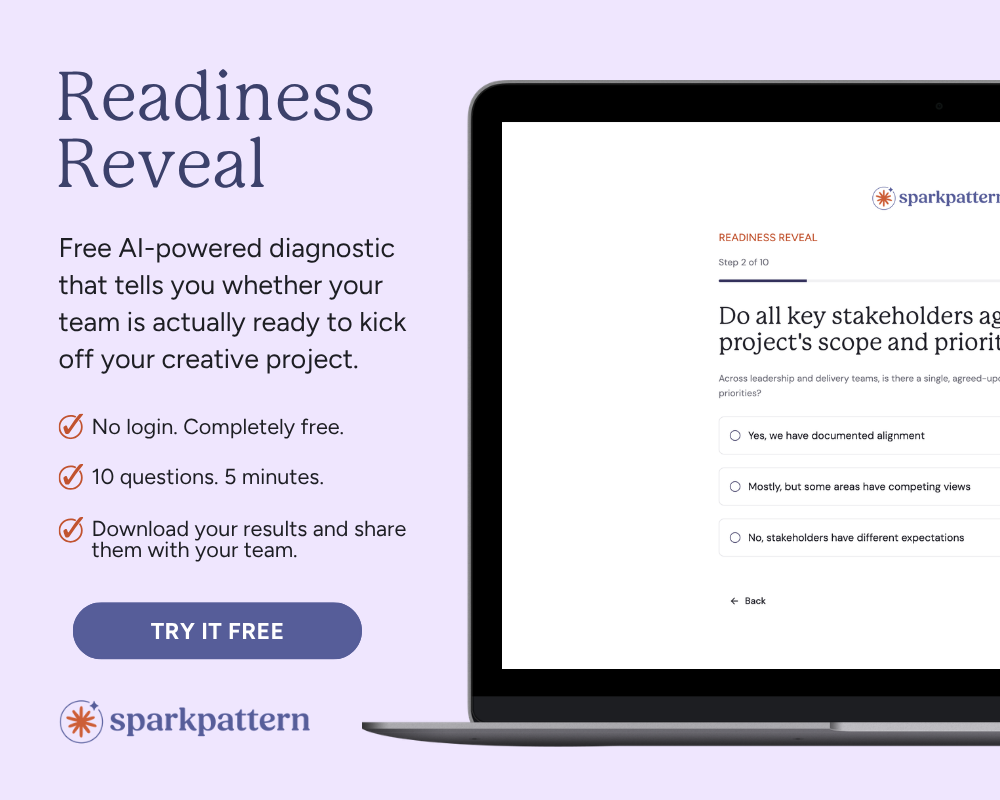
It asks 10 questions across two dimensions. Strategic Clarity looks at whether your team has defined the right problem, knows who they’re designing for, and has a measurable definition of success. Operational Readiness looks at whether the structure to execute actually exists: stakeholder alignment, decision ownership, brand foundation, dedicated resources, and a timeline grounded in reality rather than optimism.
Most teams are stronger in one dimension than the other. The assessment tells you which, and what to do about it before execution begins.
The assessment takes about five minutes. No login. No email gate. No sales call required to see your results.
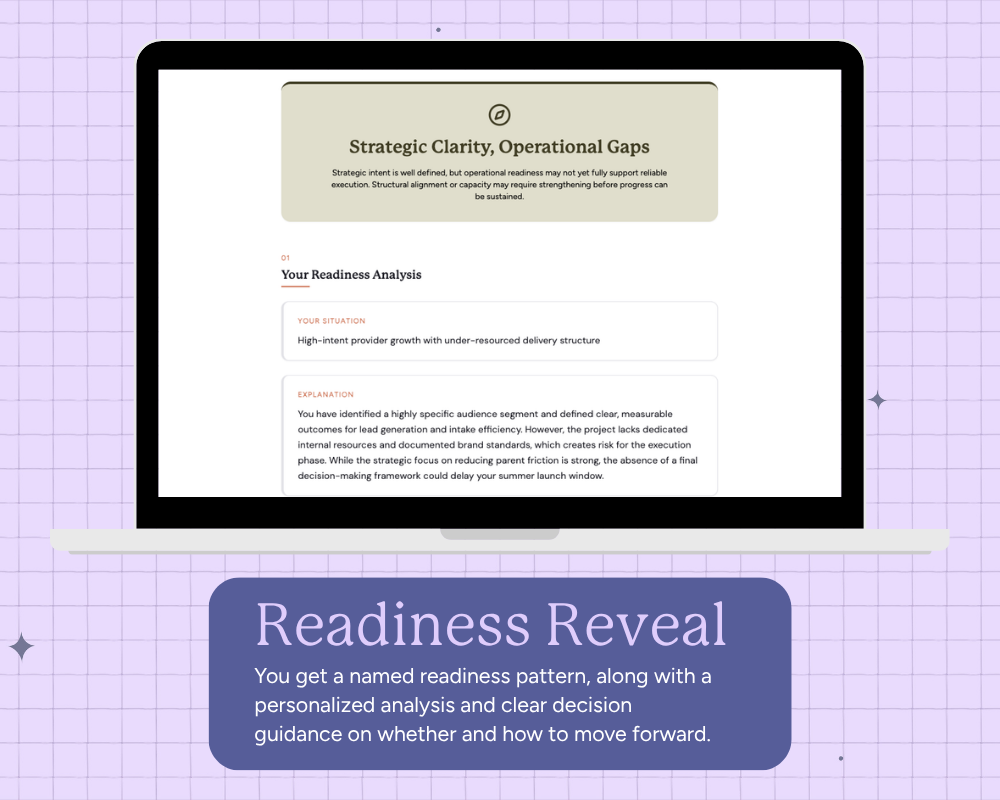
What you get back isn’t a score from 1 to 100. You get a named readiness pattern, one of four, along with a personalized analysis that names what’s working, what’s missing, a stabilizing action to take before you start, and clear decision guidance on whether and how to move forward.
The output is designed to be useful in the room. Share it with your team, bring it to a planning conversation, or use it to pressure-test your project plan before the agency is briefed. It gives you a common language for the gaps that usually don’t get named until they’ve already caused damage.
The four readiness patterns
Ready to Proceed
Strategic direction and operational structure are aligned.
Strategic Clarity, Operational Gaps
Strategic intent is well defined, but operational readiness may not fully support reliable execution.
operational readiness, strategic drift
Execution capacity is present, but strategic clarity may not be sufficiently defined to guide effective decisions.
not ready to proceed
Both strategic alignment and operational readiness require stabilization.
Most teams assume they’re in the first category. The honest reality is that most land in the second or third.
- Ready to Proceed. Strategic direction and operational structure are aligned. The team has a clear picture of who they’re serving, what problem they’re solving, and how they’ll measure success.
- Strategic Clarity, Operational Gaps. The vision is well-defined, but the execution structure isn’t there yet. Decision ownership is murky, resources are shared, or the timeline is aspirational rather than realistic. The strategy is solid, the infrastructure to deliver it isn’t.
- Operational Readiness, Strategic Drift. The team has capacity, process, and structure. But the “why” behind the redesign isn’t well framed with business outcomes. A capable team executing toward a vague goal is still executing toward a vague goal.
- Not Ready to Proceed. Both strategic clarity and operational readiness need stabilization before the project begins. Common signals: undefined success metrics, competing stakeholder priorities, and a problem statement framed around aesthetics rather than outcomes.
Clarity Before Execution
There’s a principle that runs through everything Spark Pattern does: clarity first. Alignment second. Execution third.
That’s the sequence. And skipping the first two steps doesn’t make execution faster, it makes it more expensive.
Readiness Reveal is designed to give you the clarity that should precede every major initiative. To surface the misalignments that are too close to see from the inside. To tell you, before you spend the budget, where you actually stand.
It’s free. It takes five minutes. It’s the clearest signal you’ll get before your next project kicks off.
Know before you build.
Readiness Reveal is a free AI-powered diagnostic that tells you whether your team is actually ready to kick off your creative project. Answer 10 questions across two dimensions.