Most teams are working harder than they ever have. Campaigns launch on schedule, content ships consistently, dashboards fill up with charts and numbers, and there is no shortage of activity to point to at the end of the month.
And yet, when leadership asks a deceptively simple question, “What’s actually working?”, the answer often feels uncomfortably vague.
That hesitation isn’t a talent problem, and it isn’t usually a tactical one either. More often, it traces back to something that never fully happened at the beginning. What they’re missing is strategic marketing alignment, the connective tissue between business goals and the execution meant to achieve them.
Business goals were set, but they were never translated into clear strategic themes that explained how those goals would be achieved. Those themes, in turn, were never translated into specific, time-bound objectives that defined what success actually looked like. And without that clarity, teams never aligned on which priorities mattered most, how progress should be interpreted, or what the metrics were actually meant to signal.
When “working” isn’t translated at each of those points up front, execution fills the gaps. Teams stay busy. Metrics multiply. But even strong execution struggles to explain its value after the fact.
Goal ➜ Theme
Broad goals must be translated into clear themes that explain how the goal will be achieved.
Theme ➜ Objective
Themes must be defined by specific, time-bound objectives and success criteria.
Objective ➜ Alignment
Alignment requires teams to agree on priority, timing, and what the metrics actually mean.
Why strategic marketing alignment breaks down before execution starts
This pattern shows up the same way in organization after organization.
Leadership sets a clear business goal, something concrete and directional, like “Achieve $10M in new revenue from the healthcare vertical within 18 months.” The goal is communicated, supported, and understood at a high level. Everyone agrees it matters.
What rarely happens next is the work of translation.
Business goals describe what needs to happen, but they don’t explain how that outcome will be achieved. Without translating the goal into shared strategic direction, teams move quickly into execution. Social plans get built, content calendars fill in, paid campaigns go live, email sequences are mapped, websites are updated. Metrics are tracked because they’re available, dashboards are created because tools make it easy, and reporting becomes a stand-in for clarity.
A few months later, the team presents results across dozens of metrics pulled from multiple platforms. Page views are up. Engagement looks strong. Email performance is healthy.
Then leadership asks the question those metrics were never designed to answer: are we actually making progress toward the healthcare revenue goal?
Sometimes it’s phrased more narrowly, is awareness increasing in the healthcare market, but the underlying issue is the same. No one can answer with confidence, not because the work failed, but because the goal was never translated into a shared understanding of progress. Measurement followed availability instead of intention.
Translating goals into strategic themes
This is the first translation most teams skip.
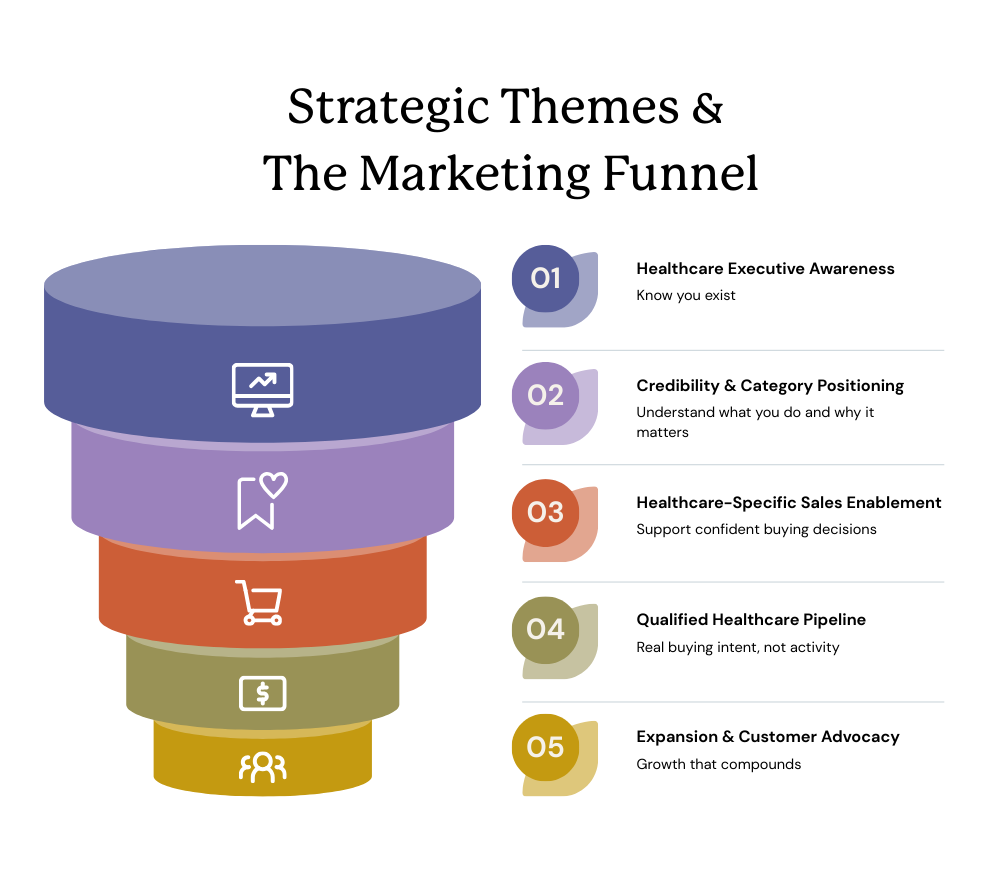
A business goal like “$10M in healthcare revenue” is not a single marketing motion. It requires coordinated progress across several distinct strategic themes, each explaining how the goal will be achieved over time.
That revenue depends on:
- Awareness among healthcare executives, so prospects know you exist.
- Credibility and category positioning in healthcare IT, so they understand what you do and trust your expertise.
- Sales enablement that speaks directly to healthcare use cases, so deals can close.
- Qualified pipeline that reflects real buying intent, so there are opportunities to convert.
- Expansion and advocacy in early healthcare customers, so success compounds.
When those themes aren’t named explicitly, teams are forced to guess what matters most. Marketing may over invest in awareness while sales lacks the proof points needed to convert interest into pipeline. Or the team may push aggressively on lead generation before the market has enough context, driving up acquisition costs while lowering lead quality.
The issue isn’t effort. It’s that the goal never became a shared map for action.
Strategic themes don’t slow execution. They make execution complete, coordinated, and anchored to the outcome the business actually cares about.
When themes never become measurable

Even teams that take the time to define strategic themes often stop one step short.
“Increase brand awareness among healthcare executives” sounds directional, but without translation into measurable objectives, it remains open to interpretation. One person tracks followers, another reports impressions, another watches traffic, and another focuses on engagement. These metrics may correlate loosely with awareness, but they don’t answer the strategic questions guiding execution.
Without that clarity, teams end up confusing activity with progress.
They can’t confidently answer which audiences matter most right now, which channels deserve priority, or what level of change actually signals meaningful progress. Measurement fragments across tools and teams, and meaning gets assigned after the fact rather than designed upfront.
This is the second critical translation: turning themes into objectives that define success clearly enough to guide decisions.
What makes a strategic theme actionable
A strategic theme becomes actionable when it’s translated into clear, measurable objectives tied directly to the business goal. In practice, those objectives usually fall into two complementary categories.
Some objectives measure awareness directly, capturing whether perception in the market is actually changing. Others act as leading indicators, signaling momentum earlier, before those shifts show up in formal surveys.
Direct measures of awareness might include objectives like:
- Increase aided brand recognition from 23% to 35% among target healthcare executives within 12 months.
- Increase unaided brand recall from 28% to 40% among companies with 500+ employees in the Northeast region by year-end.
- Grow share of voice in the healthcare technology conversation from 8% to 15% by end of Q4.
Leading indicators of awareness momentum often look like:
- Increase branded search volume by 50% year-over-year in target geographic markets.
- Secure 50 or more media mentions in top-tier healthcare industry publications within 12 months, tracked through media monitoring tools.
- Grow brand mentions in target audience social conversations from 200 per month to 500 per month within 12 months.
Metrics that are easy vs. metrics that matter
Easy to track
- Pageviews
- Impressions
- Social reach
- Follower growth
Tied to awareness progress
- Aided brand awareness
- Unaided brand recall
- Share of voice
- Branded search volume
Together, these objectives do more than populate a dashboard. They define what progress actually looks like, align teams on what matters most, and give execution a clear standard to work toward.
But even well-defined objectives don’t guarantee alignment.
Where alignment quietly erodes

This is the third translation, and the one teams most often underestimate.
Even when goals, themes, and objectives are clearly defined, strategy still fails if teams don’t share the same understanding of how to interpret and prioritize them.
Marketing, sales, and leadership may all reference the same strategy yet operate with different assumptions about what matters most right now. Marketing emphasizes top-of-funnel awareness. Sales expects mid-funnel readiness and conversion support. Leadership looks for movement toward the business outcome itself. Each group makes reasonable decisions locally that don’t add up collectively.
Misalignment becomes most visible at handoff points. Leads are debated instead of acted on. Campaigns are questioned after launch rather than improved. Reports prompt justification instead of decision-making. The issue isn’t performance. It’s that teams were working toward different interpretations of the same objectives.
The pattern compounds over time. Dashboards begin to reinforce the problem rather than resolve it:
- Marketing reports engagement
- Sales reports pipeline
- Leadership looks for business impact
Without a shared narrative connecting those signals, measurement deepens silos. Prioritization turns reactive. The most urgent request gets attention. The loudest stakeholder influences the roadmap. Focus shifts quarter to quarter without a clear throughline, and momentum erodes without anyone being able to point to a single failure.
Alignment isn’t created by documentation alone. It requires everyone to operate from the same understanding of what success means, how objectives should be interpreted and weighted, and how progress should be read across teams. When that shared understanding exists, strategy stops being a plan and starts functioning as a system.
The cost of skipping this work
When strategic clarity and alignment are missing, the consequences compound quietly over time.
Budget flows toward tactics that are easy to execute or politically safe rather than toward strategies designed to move the business forward. Teams fund motion instead of progress, often without realizing it until results stall.
Proving impact becomes increasingly difficult. Leadership asks for outcomes. Marketing reports activity. The gap erodes trust. When budget reviews arrive, teams struggle to defend spend because effort was measured instead of outcomes tied to objectives.
The human cost shows up as well. Executing without clear priorities is exhausting. Teams second-guess decisions, revisit settled questions, and spend more time aligning than doing. When handoffs break down and progress feels ambiguous, good people disengage.
Every quarter begins to feel like starting over. Priorities reset without a clear thread connecting them. Teams execute in disconnected sprints instead of building momentum. Institutional knowledge doesn’t accumulate because there’s no stable framework to learn from and improve upon.
None of this reflects a lack of talent or commitment. It reflects a sequence problem.
What changes when clarity comes first
Strategy before execution changes everything because it establishes shared understanding before resources are committed.
When teams are aligned on goals, themes, and objectives, measurement sharpens. Instead of tracking dozens of disconnected metrics, teams focus on a smaller set of KPIs that clearly indicate progress toward business outcomes.
Tactical decisions gain clear rationale. Choices about channels, campaigns, and investments connect back to documented priorities, making tradeoffs easier and conversations more productive.
Stakeholder alignment reduces friction. When everyone works from the same frame of reference, handoffs smooth out and coordination overhead drops. Reporting becomes a tool for learning and adjustment rather than justification.
Most importantly, teams can clearly show impact. When KPIs connect to business objectives, marketing doesn’t have to defend its existence. The conversation shifts from proving value to scaling what works.
Decision-making speeds up. Energy aligns. Retention improves because people can see how their work contributes to meaningful outcomes.
A sequence that supports sustainable execution
This shift happens when teams follow a deliberate rhythm that prevents them from jumping straight from ambition to activity.
- Business understanding leads to actionable planning.
- Actionable planning leads to success measures.
- Success measures guide data identification, goal setting, monitoring, and optimization.
That sequence turns ambiguous goals into measurable progress and makes execution sustainable rather than exhausting.
A more grounded place to start
If execution feels busy but unclear, start by testing alignment before adding more tactics.
- Ask a few stakeholders what success looks like right now. If the answers differ, clarity and alignment are missing.
- Look at how priorities get funded and defended. If influence or urgency drives decisions more than strategy, themes aren’t guiding execution.
- Review your metrics and map them back to business objectives. If the connection feels forced, you’re measuring activity, not progress.
Add alignment before adding tactics. More execution won’t fix an unclear strategy.
Clarity first. Alignment second. Execution third.
That’s the pattern that makes marketing work.
Ready to establish strategic clarity?
The Strategic Alignment Sprint is a 2–6 week engagement that connects business objectives to measurable outcomes and aligns stakeholders before execution begins.