
Strategy
Doing digital marketing does not mean you have a strategy
A simple way to tell whether your digital efforts adds up to a strategy.
The activity is real but the alignment is missing
I’ve spent the last decade working at digital agencies doing web development for enterprise clients, retail, fintech, nonprofits, midsize businesses, you name it.
What’s funny to me is that the size of the client does not always mean they have strong internal processes. You would think a large organization would have all of this figured out, but that is not always the case. When everyone is caught up in deadlines and trying to get a campaign launched, it is really easy to lose sight of the strategy.
I was working with a client whose digital marketing team was responsible for developing and launching websites and microsites for different campaigns. They managed the work, but the business partners were the primary owners. The digital team often received a request without much information about how the microsite was supposed to support a business goal.
As their agency partner, we were building a component design system in WordPress that allowed them to launch new microsites much faster than they had in the past. I’m talking three weeks instead of six months, which before vibe coding tools, was a huge improvement.
But once we were able to build sites that quickly, it also became easier to move from one launch to the next without stopping to define the strategy behind each one.
We launched the sites, and for many, paid media campaigns ran. While the campaigns had performance metrics, the websites themselves did not have a measurement plan as part of their launch strategy. We could see how the paid media performed, but we had not defined what success looked like for the experience people reached after they clicked.
That gap existed while the campaigns were running, but it became even more obvious when the paid media stopped. The team had no process for deciding which sites to retire and which ones to keep running. For the sites that stayed live, we still needed an ongoing strategy and a clear way to show their value to the business partners who had requested them.
After the initial component system was built and several sites were launched, we finally had some breathing room and were able to step back and revisit the questions that had been pushed aside during the launches.
A colleague and I ended up creating and leading a series of workshops with the client where we worked through:
- What business goal does this microsite support?
- Who is the audience?
- How will we measure success?
- Who is responsible for managing and updating the site?
This gave the digital team and the business partners a shared way to talk about the sites and we received so much positive feedback on how these exercises helped make their internal business processes and outcomes stronger.
The team had been doing a lot of digital work, but having digital activity didn’t mean they had a digital strategy. The piece that had been missing was a shared understanding of what the work was supposed to accomplish.
How the work comes together
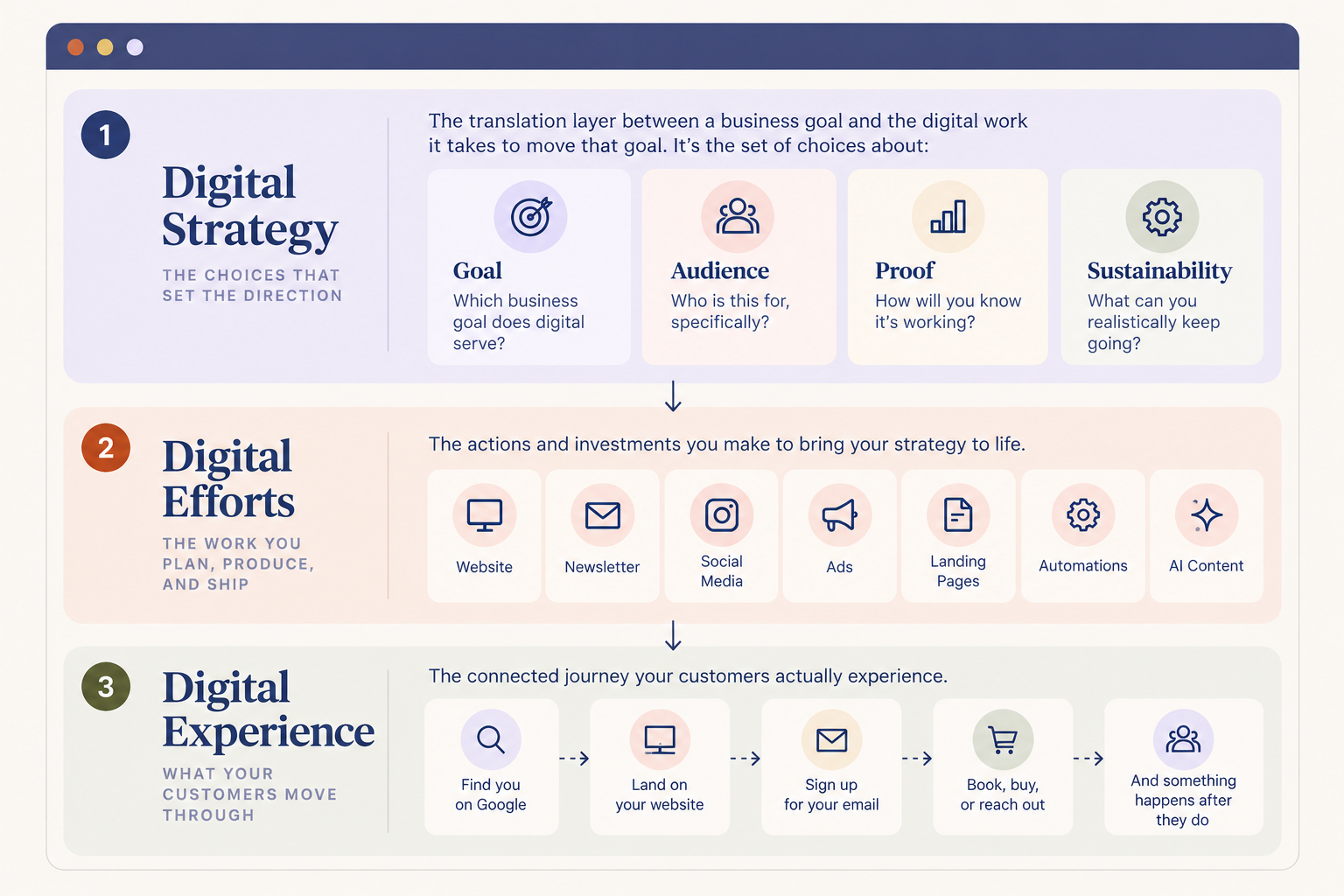
I think it helps to step back and look at three different things: your digital efforts, the digital experience your customer has, and the strategy connecting the two.
Your digital efforts are the things your team does every day. That might include:
- Publishing an Instagram post
- Sending a newsletter
- Running an ad
- Updating website content
- Building an automated email series
- Using AI to create new content
Your customer sees the full output of that work as digital experiences. They might search for your business on Google, land on your website, join your email list, and later buy a product, book a call, or fill out a form.
Your customer does not experience those things as separate efforts, it is one journey for them, and your brand needs to show up in the right way across each of those touch points.
Digital strategy is the work that connects those efforts to the business goal. It defines:
- What business outcome the effort supports
- Who you want to reach
- What you want them to do
- How you are going to measure success
- What constraints your team is working with
- Whether your team has the capacity to sustain the work
These decisions also help you understand what not to do and what work to say no to. If an effort does not support a business goal, serve a specific audience, or fit the way your team works, moving forward with it does not magically make it strategic. All it does is create noise and give your team one more thing to manage. Don’t do it!
The cost usually shows up in small disconnects
A lot of businesses think they need to be on a channel because their customers are there or because they see competitors using it, but that is not enough to define a strategy. You still need to understand how the channel supports the business, what role it plays in the customer experience, and whether your team is set up to manage it well.
It is easy to start a Facebook page, add an email series, build a resource hub, or set up a new automation. It is also easy to add AI to a process because you want the work to move faster.
Each decision might make sense when you look at it on its own. The problems start when everything is approved separately, without checking how it supports the business, fits the customer experience, serves the audience, or affects the people responsible for maintaining it.
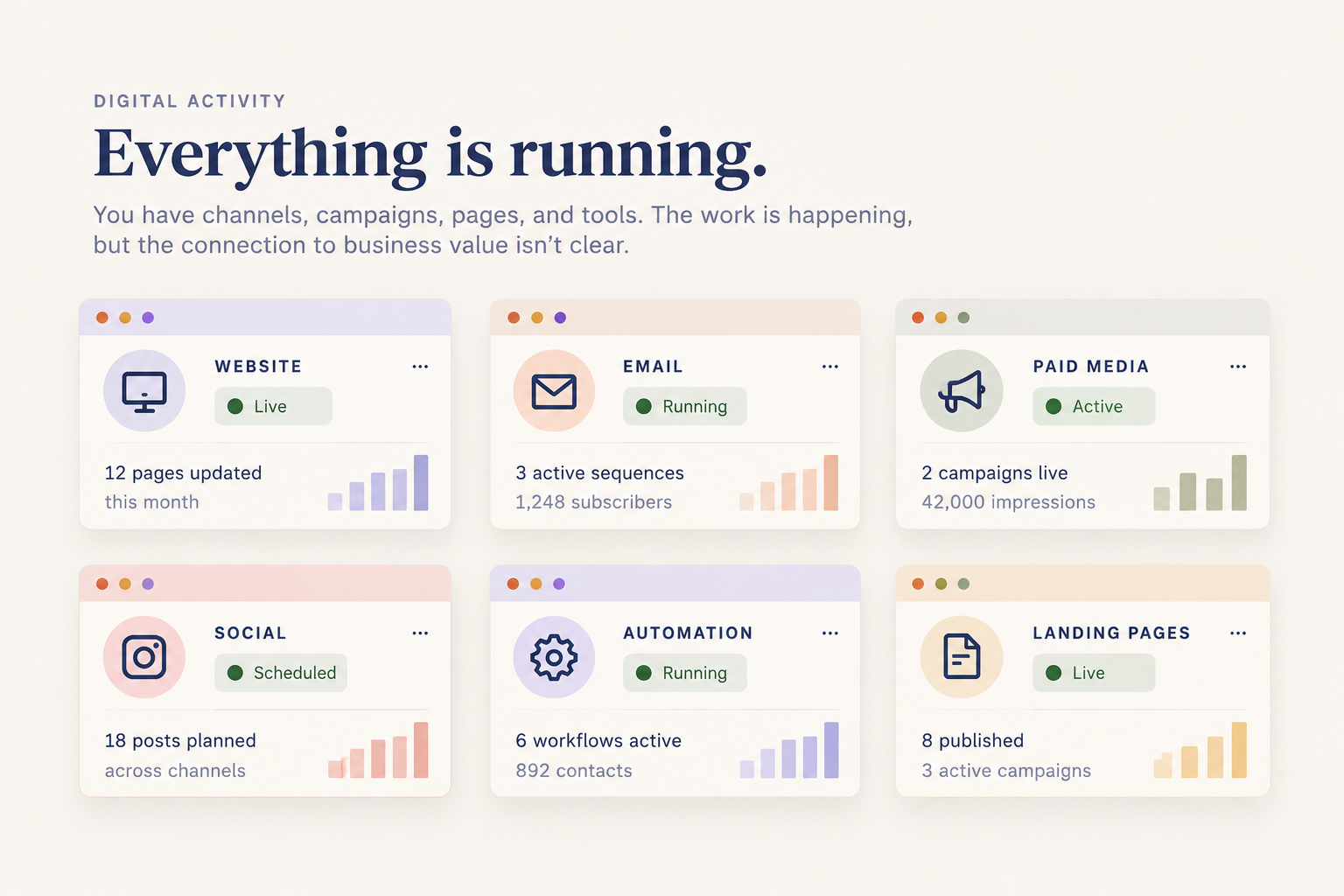
That is how teams end up feeling busy without feeling clear. They have channels, campaigns, pages, dashboards, automations, and tools, but no shared understanding of how the pieces fit together or which ones deserve their attention.
- An ad promises something the landing page does not support because different teams managed the work and did not align on the experience.
- An automated email keeps promoting an offer that no longer exists because everyone forgot the sequence was still running.
- A dashboard goes out every month, but no one uses the metrics to decide whether the work should change, stop, or receive more investment.
- AI increases content output without making the content more relevant. Now the team has more content to manage.
As those disconnects add up, the customer experience becomes less consistent. The team spends more time maintaining, correcting, and reworking what it already has. Some of that time would have been better spent defining the strategy up front.
Start with an inventory
One of the first things I think every marketing team should do is take an inventory of all the digital work the business is running right now.
Start with the channels that are top of mind because you are working in them every day:
- Your website
- Your social accounts
- Your newsletter
Then add the work running in the background. Look for old landing pages, ad campaigns, automated emails, dashboards, integrations, and paid tools.
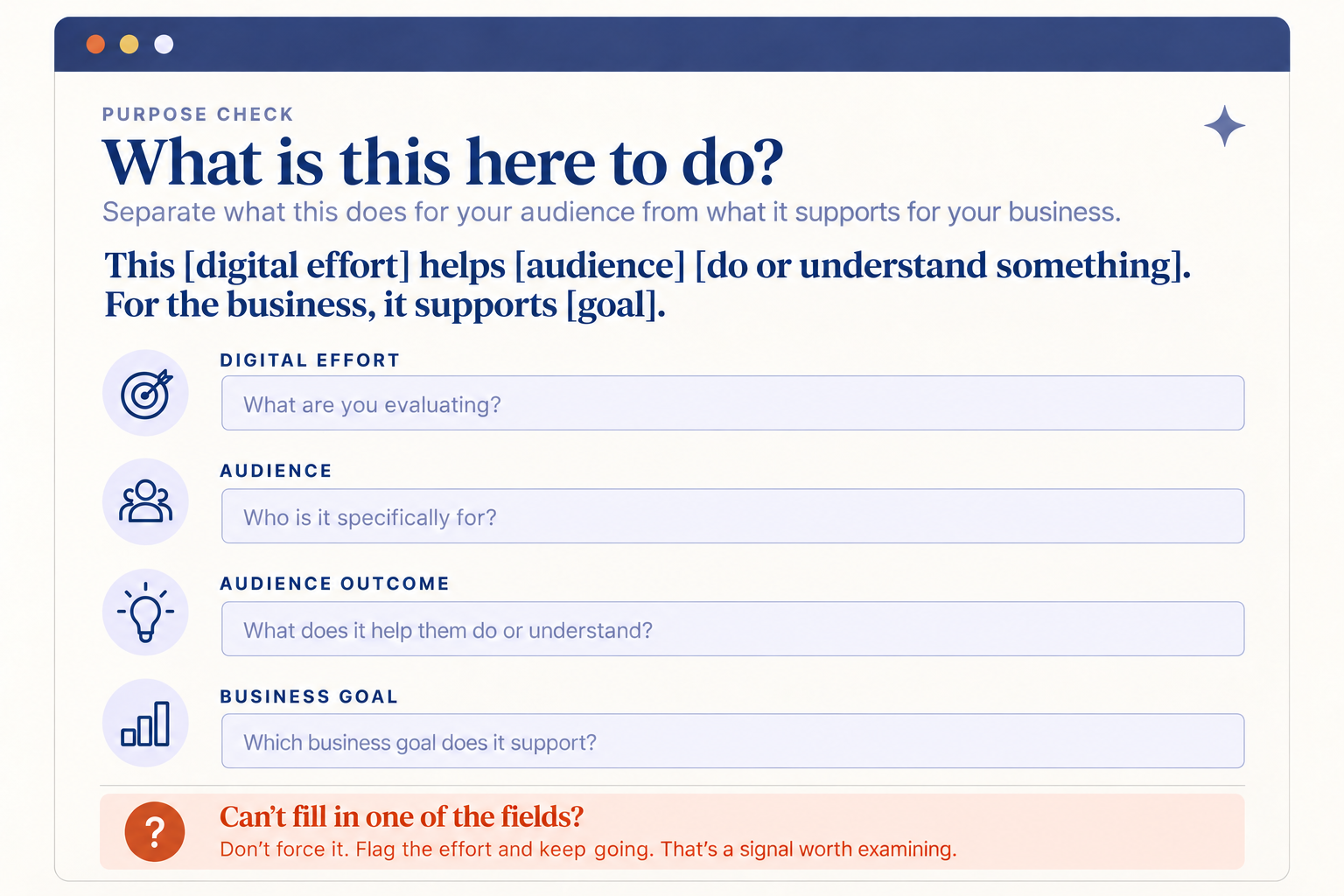
For each item, finish this sentence:
This [digital effort] helps [audience] [do or understand something]. For the business, it supports [goal].
The point is to separate what the effort does for the audience from what it is supposed to do for the business. If either statement is hard to complete, you have found something that needs more thought.
Here are a few examples for a fictional bookkeeping firm that serves small businesses.
- Welcome email series: This welcome email series helps small business owners who joined the firm’s email list understand what to expect from the newsletter and learn more about the firm’s services. For the business, it supports the goal of building familiarity with potential clients and giving them a path to book a consultation when they need help.
- Monthly bookkeeping service page: This service page helps small business owners understand what is included in monthly bookkeeping, what the onboarding process looks like, and whether the service fits their needs. For the business, it supports the goal of generating consultation requests for the firm’s monthly bookkeeping service.
- Bookkeeping cleanup landing page: This landing page helps small business owners whose books are not ready for tax filing understand the firm’s cleanup service and how to get started. For the business, it supports the goal of selling one-time bookkeeping cleanup services before tax filing deadlines.
If you cannot name the audience, the intended result, or how the effort connects to the business, flag it. That uncertainty is useful. It shows you where the gaps are.
Use GAPS to test your strategy
Even if you do not have a digital strategy written down, you still have one. Your current strategy is reflected in the work you are choosing to do. The question is whether those choices add up to a good strategy.
GAPS is a simple framework I use to check four parts of any digital effort: its Goal, Audience, Proof, and Sustainability.
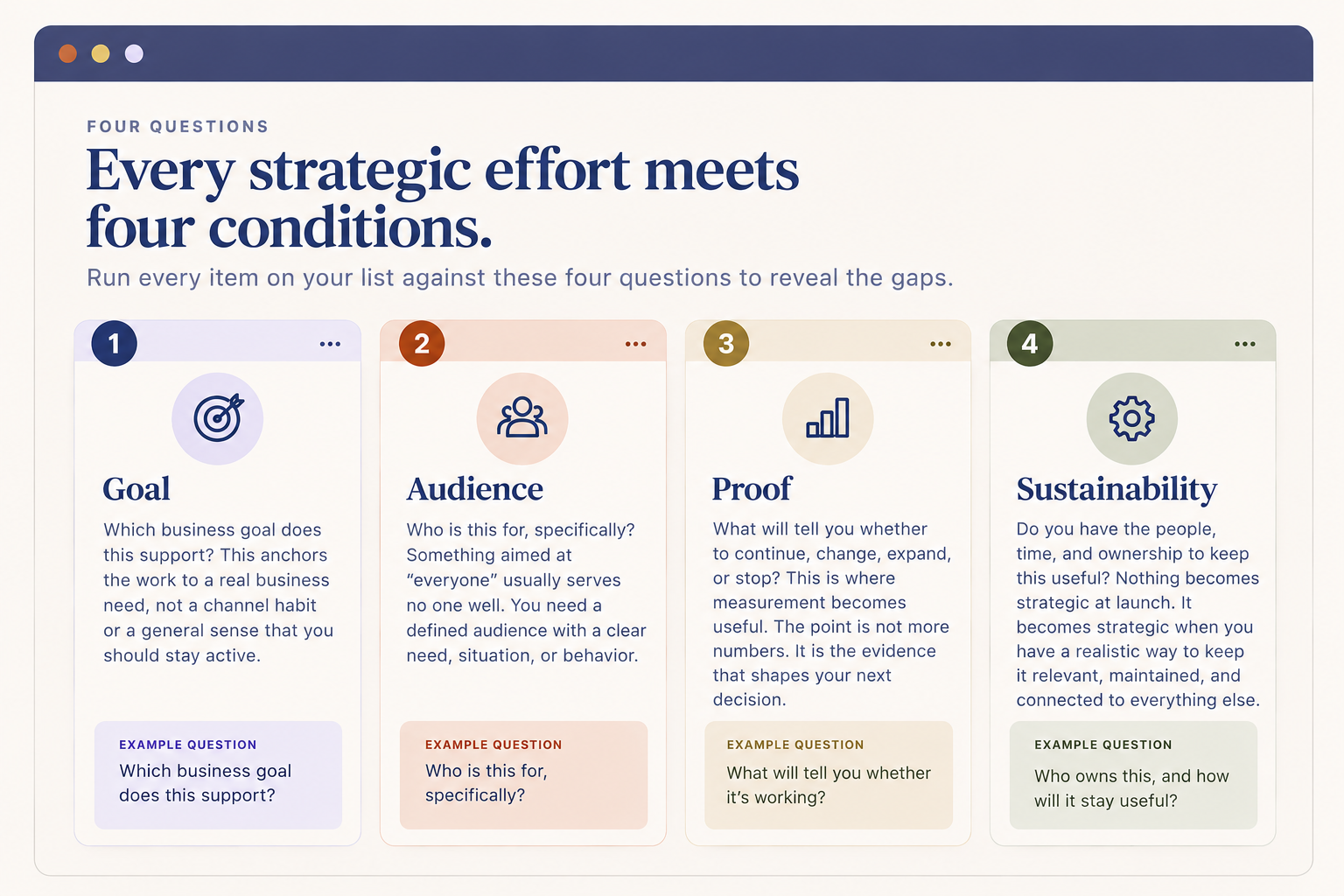
1. Goal
What business goal does this support?
And I do not mean, “awareness” or “we need to be there because our customers are there.” I want to know what result you are looking for and what business outcome the work is supposed to support.
Maybe the goal is to increase revenue by 10%, bring in more qualified leads, grow your client base within a new vertical, or increase repeat purchases. Whatever it is, you need to be able to define it.
2. Audience
Who is this for, specifically?
A broad audience such as “everyone” or “all of our customers” does not give you enough direction. Name the group, the situation they are in, the behavior you are trying to support, and the need this effort addresses. Be as specific as possible.
3. Proof
What would tell you to continue, change, expand, or stop?
You do not need a list of ten metrics, you need to pick the one or two that will help you decide whether the effort is working. If a number would not change what you do next, it is not worth reporting. Drop it from the list!
4. Sustainability
Who owns this, and do they have the capacity to keep it useful?
If an initiative does not have a clear owner, no one is going to take responsibility for managing it. But naming an owner is only part of the answer. Does that person have the time and bandwidth to do the work well?
If they don’t, the output will suffer and the customer is often the person who feels the impact in the end.
Keep it, fix it, or retire it
After you review your digital efforts, sort each one into one of three groups:
- Keep: It has a clear goal, a defined audience, a useful proof point, and an owner with the capacity to manage it.
- Fix: One part is weak, but the team knows what needs to change and the issue is correctable.
- Retire: It no longer supports a relevant goal, or it does not deserve the time it takes to manage. I know it’s hard to retire things, but I promise you are only creating space for more relevant work.
As you sort the list, watch for the same issue showing up again and again. If you keep getting stuck on Audience, the problem is larger than any one email, page, or campaign. You need to spend more time defining who you are trying to reach.
GAPS evaluates each effort on its own, so it will not show you every break between them. A landing page and an email series might each pass the test and still create a confusing handoff for the customer. That connection deserves a separate review, which I will get into in a later post.
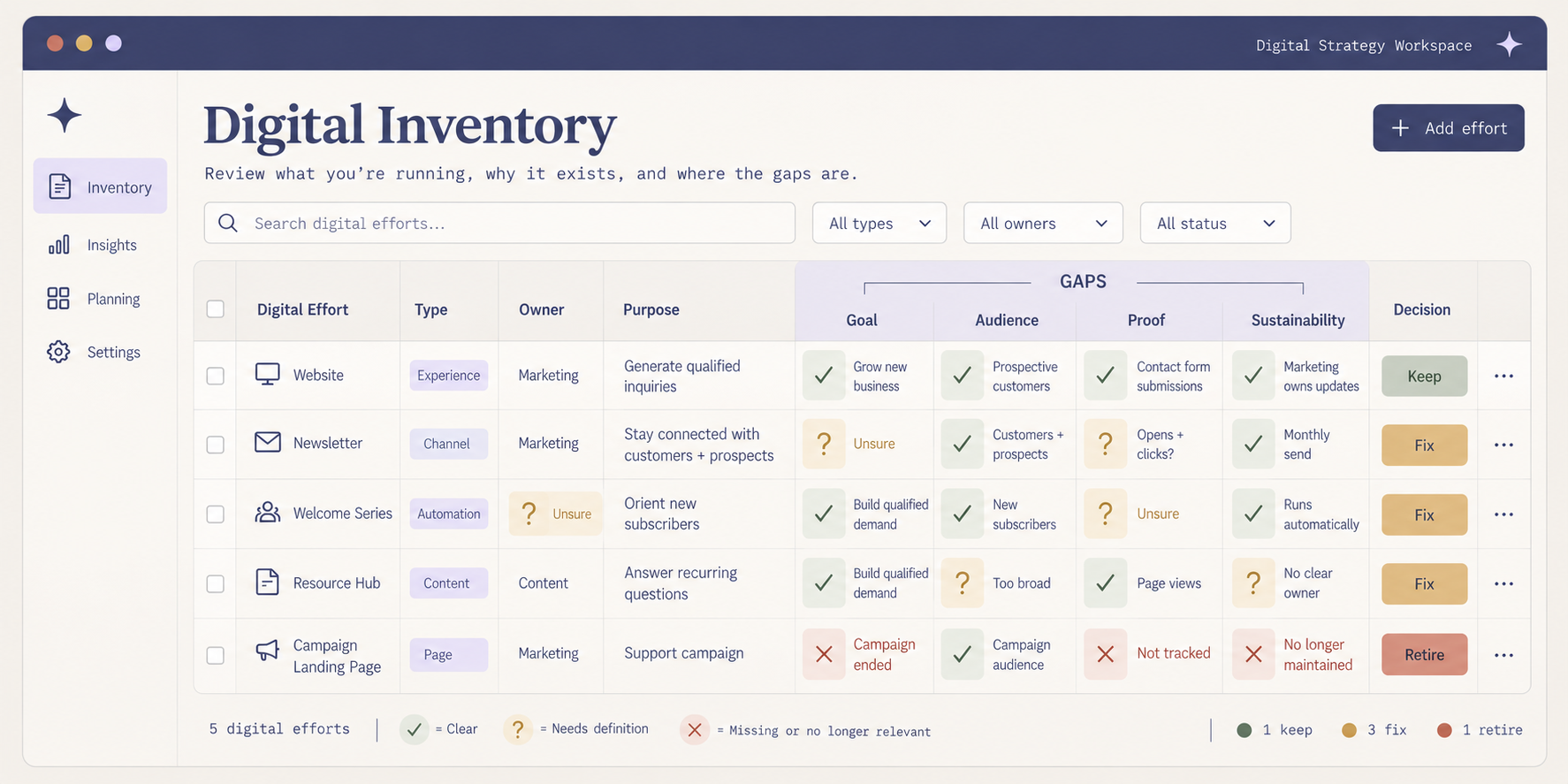
This image shows a team name for the owner, but I highly recommend you include a name of a specific individual whenever possible.
Where AI helps
I am a strong proponent of AI, and I think it is useful for organizing information. But it is only as useful as the information you give it, and there is still a lot of discernment and human judgment involved in this process.
AI can help with the tedious parts of this exercise. It can organize a messy inventory, identify missing fields, test vague purpose statements and act as a sparring partner. Use it to reduce the time you spend sorting and organizing the information but do not let it decide which work deserves your budget and attention. You have to make that call.
Below I’m sharing a couple of prompts that can help you with the first part of this exercise.
Organize your list
Your list is probably a bit messy, with channels, pages, and maybe a few tools you forgot you’re still paying for. (Bonus: canceling the ones you don’t need can free up some budget.) Paste it in as-is and ask:
Here’s a list of everything digital my business has running. It’s messy, so help me organize it.

Put it into a table with these columns: Item, Type, Audience, Owner, Purpose.

Group similar items together under these types: channels, website pages, email and automations, tools and subscriptions, and reporting.

If my list doesn’t say who something is for or who owns it, leave that cell blank. Don’t guess.

At the end, list every item that has no clear audience or no owner.

[Paste your list here]
Those flags are your first clues. The item with no owner is often the one nobody has checked in months.
Stress-test your purpose sentences
Once you’ve written a purpose sentence for each item, ask AI to poke holes in them. The last line especially matters because you want to see where your thinking is fuzzy, not get a polished sentence that hides it. You’ll be surprised how many of your own answers don’t hold up.
Below are purpose sentences for the items in my digital inventory. Each one follows this format: “This [digital effort] helps [audience] [do or understand something]. For the business, it supports [goal].”
For each sentence, tell me:
1. Is the audience specific, or is it too broad (like “everyone” or “customers”)?
2. Is the result something I could observe or measure?
3. Does it lean on vague words like “engage,” “build awareness,” or “stay active”?
Label each sentence clear, vague, or missing a piece. Don’t rewrite them for me.
[Paste your purpose sentences here]
Before you add another campaign, platform, page, automation, or AI tool, get clear on what you are already supporting. Then run the new idea through GAPS before it launches and decide whether it is worth pursuing.
If the work does not have a goal, an audience, a useful proof point, and a realistic owner before launch, moving faster will not create the missing alignment. It will give your team more disconnected work to manage.
This is the first post in a series on digital strategy for small businesses.
P.S. When you run your list through GAPS, which letter trips you up most? Your answers will help me decide what to dig into next.